South Korea
country profile
April 2026
South Korea is an emerging outbound market for Azerbaijan’s tourism industry, with steadily growing interest in new and less conventional destinations. Korean tourists are attracted to Azerbaijan’s rich history, distinctive culture, and diverse landscapes, as well as the contrast between modern architecture and historical heritage. The destination’s uniqueness and relatively low saturation compared to traditional routes make it particularly appealing for Korean travellers seeking new experiences.
January 1: New Year's Day
February: Lunar New Year Holiday (3-4 days, dates vary each year)
May 1: Labor Day (Limited observance)
May 5: Children’s Day
July-August: Summer vacation (school holidays)
September-October: Chuseok (Korean Thanksgiving, 3-4 days, dates vary each year)
December-January (early February): Winter vacation (school holidays)
South Korean tourists primarily belong to the 25-45 age group (working professionals, Millennials and Gen Z) and the 60+ senior segment. Family travelers, honeymooners, and independent travelers are also growing segments.
City Breaks: Interest in modern urban landscapes and historical architecture.
Cultural & Heritage Tourism: Strong interest in museums and historical sites.
Gastronomic Tourism: High appreciation for local food culture and wine tourism.
Luxury & Relaxation Travel: Preference for high-end, good quality accommodation and resorts.
Adventure & Activities: Interest in hiking, skiing, hot spring experiences, visiting ‘hot’ trendy places in the city.
Shopping Tourism: Visits to traditional markets and high-end shopping districts
Detailed Planning: Thoroughly research destinations through the internet, social media, and recommendations from friends and family.
Value for Money: Prioritize destinations that offer good value for money with clear and transparent pricing.
Safety and Security: Choose destinations with a high level of safety and political stability.
Comfort and Quality: Favor high-quality accommodation and premium services, luxury or well-known brand amenities are strongly preferred.
Convenience: Value ease of travel, including direct flights, visa-free or easy visa access, and well-connected transportation systems.
Social Media Opportunities: South Korean tourists prefer visually appealing destinations that offer unique photo spots, aesthetic cafés, and well-presented food suitable for social media content.
Multi-Destination Travel: Enjoy traveling to multiple destinations in a single trip to maximize the experience.
Cultural Experience: Seek authentic cultural experiences, including local cuisine, traditional customs, and historical landmarks
The average South Korean tourist spends between USD 1,800-2,000 per trip abroad. Budget allocation: 40% on accommodation, 30% on food & shopping, 20% on transportation
South Korean travelers are among the top spenders in Asia. Average travel duration: 3-5 days, often visiting multiple destinations in one trip.
Friends and Families
Millennial generation, Gen Z
Couples
Seniors
Solo Travelers
Luxury Travelers
Social media: Instagram, YouTube, Naver Blog, Naver (local and main search engine), KakaoTalk Channels
Online Travel Agencies: Yanolja, YeogiOttae (yeogi.com), Naver Travel, Interpark, HanaTour, My Real Trip, ModeTour, Yellow Balloon Tour(ybtour.com), Lotte Tour
Travel Communities & Blogs: Naver Blog, Naver Café, Daum, online reviews
Korean tourists typically plan and book their trips in advance, with the following tendencies:
For long-haul trips, they usually plan and book up to 6 months to a year in advance, especially for destinations requiring long flights and complex itineraries.
For major holidays or international trips, they tend to plan and book 3 to 6 months in advance, particularly for peak travel seasons such as summer and winter vacations.
Short-term trips or last-minute bookings are very common, especially for domestic travel or nearby destinations in East Asia (especially to Japan) or South-East Asia, that require less preparation and have easier access, such as visa-free or simplified visa procedures.
For holiday weekends or quick getaways, booking can occur within 1 to 2 months in advance, with flexible options based on availability and promotions.
Online bookings, Self bookings
Travel agencies
Online travel agencies (OTAs)
Travel Agents: Yanolja, YeogiOttae (yeogi.com), Naver Travel, Interpark, HanaTour, My Real Trip, ModeTour, Yellow Balloon Tour (ybtour.com), Lotte Tour
Airbnb, Trip.com, Agoda, Booking.com, Klook
Influencer-Inspired Travel: Following the travel routes of influencers is popular among Koreans when making travel decisions. Travelers are increasingly inspired by travel content on Instagram and YouTube, where influencers share their experiences, and hidden gems. As a result, travelers often seek to replicate these journeys, visiting the same destinations, staying at the same hotels, following the same food and activity recommendations. Many are also influenced by current trends on social media.
Expanding Travel Destinations: Korean tourists are exploring a wider range of destinations, both nearby and long-haul. Popular visa-free countries, such as Japan, Taiwan, and Southeast Asia, continue to see high demand, while destinations like Europe and the Americas are popular for longer trips.
Rising Popularity of Customized and Small-Group Tours: Korean travelers are increasingly favoring customized and small-group tours, seeking more personalized and intimate travel experiences. This trend is especially popular among young professionals and families who prefer tailored itineraries and exclusive experiences over mass tourism.
Yanolja
YeogiOttae(yeogi.com)
Hana Tour
Mode Tour
Naver Travel
Interpark
My Real Trip
Yellow Balloon Tour(ybtour.com)
Lotte Tour
• No direct flights from South Korea to Azerbaijan; travelers typically transit via Istanbul, Dubai, or Doha, with an average travel time of 13–15 hours.
• Major South Korean airlines (Korean Air, Asiana Airlines) offer connecting flights through partner carriers.
Seoul International Travel Fair (SITF)
Korea MICE Expo
KTS Korea Travel Show
The World Tourism Industry Conference (WTIC)
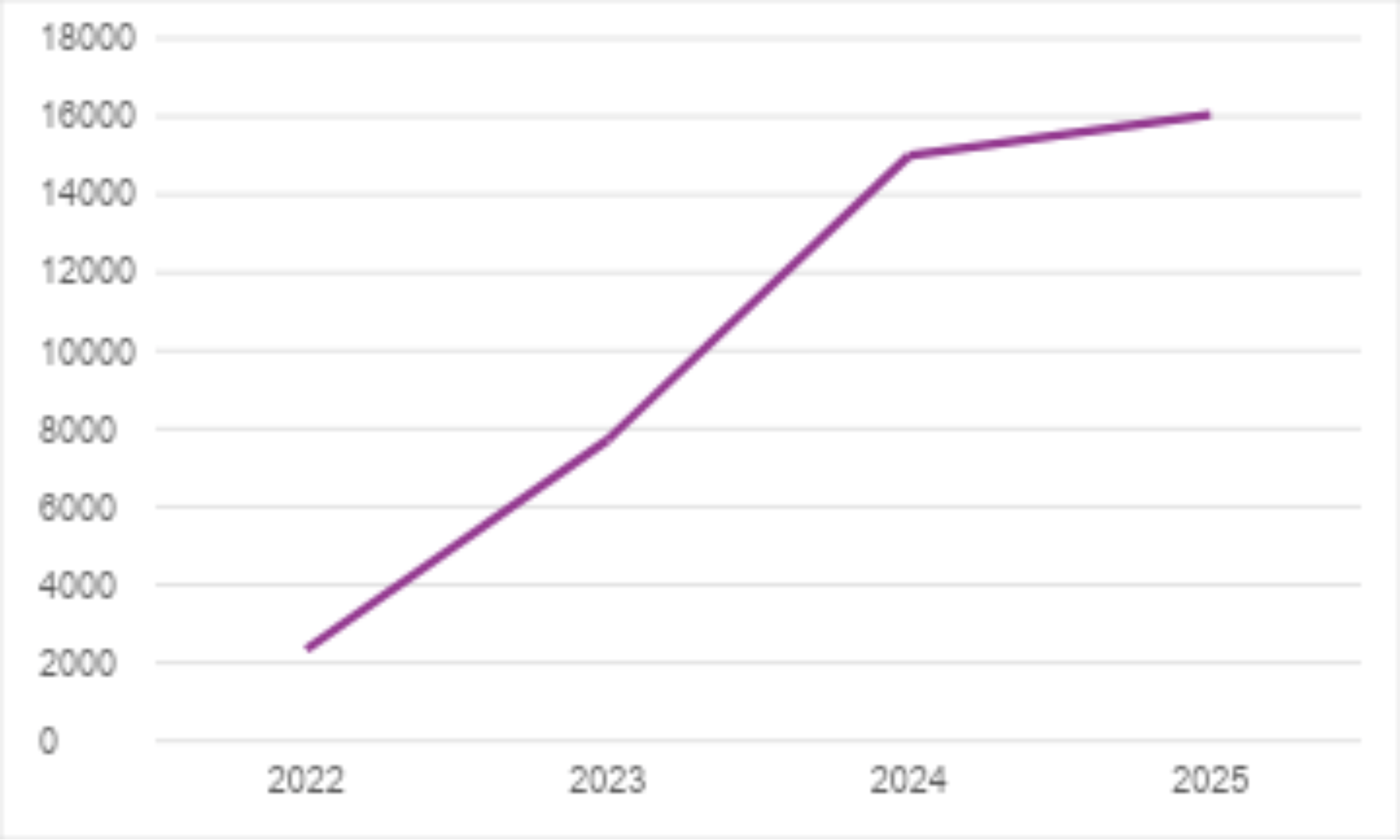
Arrivals from South Korea show strong and consistent growth over the period, increasing from 2,345 in 2022 to 7,710 in 2023 (+229%), followed by a rise to 15,004 in 2024 (+95%), and reaching 16,048 in 2025 (+7%). While growth has moderated in 2025, the overall trend indicates rapid market expansion and increasing interest in Azerbaijan as a travel destination. The recent introduction of the visa-free regime serves as an additional advantage, further strengthening Azerbaijan's competitiveness and creating favourable conditions for continued growth in visitor arrivals from South Korea.
Most South Korean visitors to Azerbaijan travel for leisure and entertainment purposes, while some visit for business reasons.
The average South Korean tourist spends AZN 300-600 per day in Azerbaijan, with approximately 40% of their budget allocated to transport, followed by accommodation (35%) and food (25%).
In 2025, 90% of South Koreans stayed in Azerbaijan for 2-3 nights, while 10% stayed for 4-5 nights.
The most visited regions by South Koreans in Azerbaijan are Baku (Absheron), Shaki and Gabala.
Korean travellers prefer diverse cultural and natural experiences, particularly those related to Azerbaijan Tourism Board (ATB) product sub-categories such as:
History & Culture: Historical buildings, monuments, museums, galleries & libraries
Nature & Healing Travel: National parks & nature areas, mountain & valley trekking, camping & glamping, birdwatching
Wellness & Relaxation: Mineral & thermal springs, spas & hammams, herbal remedies, resource-based treatments
Leisure & Activities: Sports, shopping, theme parks & entertainment centers
Local Cultural Experiences: Ethnic & cultural villages, farms & agricultural production, vineyards & wineries
Long-term Stay: Immersive local village stays, rural healing retreats
South Korea's Tourism Market Trends Show Strong Momentum:
The year 2025 is assessed as the peak of the recovery phase. Combining January–November performance (26.80 million) with seasonal year-end demand, total outbound departures in 2025 are estimated at approximately 29.47 million. This exceeds the 2025 inbound forecast (18.73 million, Yanolja Research estimate) by more than 10 million, highlighting the outbound market’s overwhelming weight within Korea’s tourism industry structure. Based on this forecasting framework, the number of Korean outbound travelers in 2026 is projected at approximately 30.23 million, an increase of about 2.6% versus 2025. While the explosive rebound immediately after the pandemic is expected to moderate, the annual total is still likely to set a new all-time high.
During the Lunar New Year holiday, a record number of 4.33 million passengers flew. According to data provided by the Korea Airports Corporation and Incheon International Airport Corporation, 4.33 million passengers (combined departures and arrivals) used 13 airports across the country from January 24 to February 2, excluding Yangyang and Muan airports. This represents a 106.8% increase compared to last year's Lunar New Year holiday, which saw 2.09 million passengers. It also marks a 64% increase compared to last year's six-day Chuseok holiday, which had 2.64 million passengers. By airport, Incheon International Airport handled the most passengers, with 2.19 million, making up half of the total. This was followed by Jeju Airport with 754,783 passengers (17.4%), Gimpo Airport with 591,200 (13.6%), and Gimhae Airport with 475,917 (11%). As for international destinations, Japan topped the list with 789,829 travelers, followed by China with 391,635 and Vietnam with 345,818.
The Korean trade values punctuality, strong relationships, and clear communication. While Korean is the native language, English communication is accepted and effective for business but the ability to communicate in Korean, even at a basic or business level, is a significant advantage.
but the ability to communicate in Korean, even at a basic or business level, is a significant advantage
KakaoTalk is the main platform for initial and follow-up/daily communications.
Face-to-face meetings are important, especially during major trade shows like KOTFA (Korea World Travel Fair) and STIF (Seoul Tourism Industry Fair). However, tourism boards are increasingly focusing on independent pop-up events to showcase their destinations and engage with a more targeted audience. These events offer a more intimate and personalized way to connect with potential partners and clients.
Key market centers to visit include Seoul, the largest hub, as well as other major cities like Busan, Incheon, and Daegu, with secondary cities like Ulsan, Changwon, and Jeonju being important for regional outreach.